
Triangulation in marketing: what it is and how to work with it

Triangulation combines attribution, incremental experiments, and Marketing Mix Modeling to answer different marketing-evaluation questions. Adam wrote up the main points from the December Penguin Webinar, our educational webinar series, on evaluation.
Until recently, marketing evaluation relied almost exclusively on attribution: a simple concept that uses a rule to allocate credit for a purchase among channels and campaigns.
Attribution has always relied on assumptions that are difficult to satisfy, as explored in this article. The cross-device problem alone is significant: people visit websites from more than one device. Legal and technical restrictions add further gaps. GDPR governs when measurement is allowed, while browsers and devices add their own obstacles, including Apple’s Intelligent Tracking Prevention.
That does not make attribution completely useless. It simply means we can no longer rely on it for some tasks, such as allocating budgets.
What can be done about it?
Unfortunately, there is no single magic replacement that lets us swap one tool for another. The answer takes considerably more work.
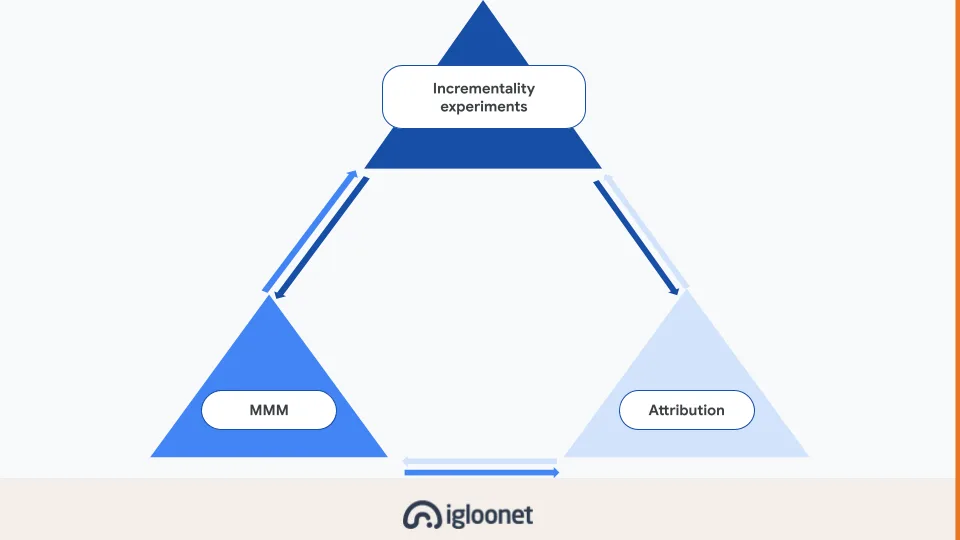
The answer appears to be triangulation: combining different evaluation methods.
Its parts are incremental experiments, Marketing Mix Modeling, and attribution.
Attribution
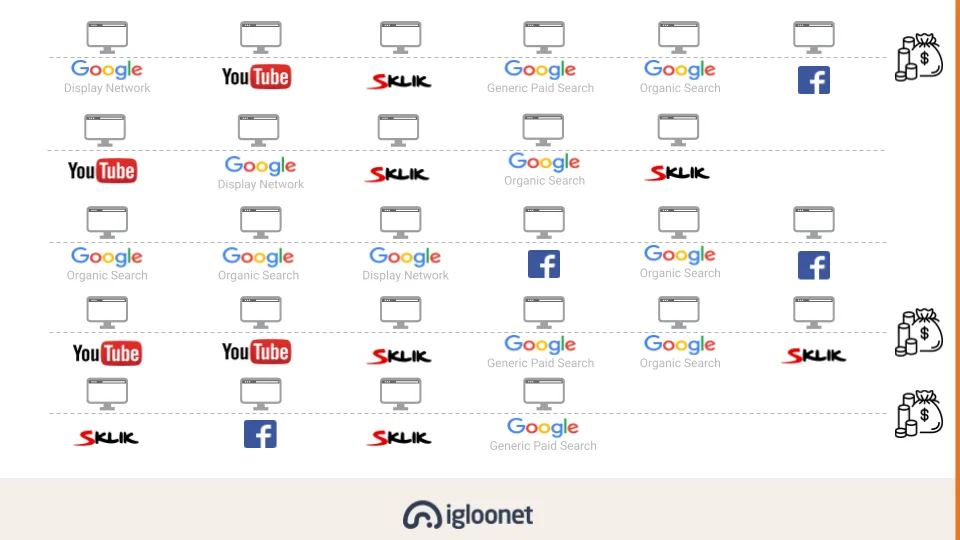
Attribution starts with a simple idea: the reason a customer decided to buy is hidden somewhere in their purchase journey. A model then assigns credit, either with a simple rule—such as giving it all to the last source in the journey—or through a more sophisticated "data-driven" calculation.
Every web analytics tool and ad platform uses attribution, but they do so in fundamentally different ways.
If you evaluate campaigns in Meta, for example, the numbers may seem inflated: Facebook appears to claim more credit than it deserves. The reason is simple. Meta does not see every source through which a customer reaches a website. It records that a user clicked campaign A on Facebook and then, a few days later, bought on the advertiser's site. It may not see that, in between, they went through Google, Heureka (a Czech comparison-shopping service), and Sklik (Seznam’s Czech advertising platform) remarketing. Add conversions from different ad tools this way and the total will inevitably exceed the purchases recorded in the admin.
That is precisely the advantage of tools such as Google Analytics, Mixpanel, and Roivenue. Because they calculate attribution across all channels, they can perform conversion deduplication. GA cannot show more conversions than actually occurred—unless, of course, there is an error in the measurement.
Attribution is often compared to a football match. We do not want to credit only the strikers who score the goals; we want to understand how the other players contributed to the win too. But the analogy works only if we evaluate the first and second halves separately, ignoring any relationship between them. On top of that, our TV signal keeps breaking up, so we occasionally miss a pass. Is that enough evidence to make decisions about next season's squad? Probably not. It may, however, be enough to decide whom to substitute and send to the bench in a given half.
Let's stay with football a little longer. Remember the games we played in elementary school: the class somehow split into two teams and got on with it. Now imagine Frank. He is not much of a player, but he is smart enough to work out which team is more likely to win and join that one. If, at the end of the school year, we name the best player solely by counting appearances on the winning team, who takes home the trophy? Some platforms and ad models behave exactly like Frank. They estimate which users are likely to buy anyway, then show those users an ad to squeeze themselves into the purchase journey.
Paradoxically, the simple last-click model, which gives every conversion to the last known source, suffers much less from our inability to match visits across devices or from cookie-related gaps in the data. It cares only about the last visit; everything before that falls outside its scope.
Incremental experiments

Unlike attribution, incremental experiments do not care what the customer journey looks like, how many touchpoints it has, or about complex allocation. They estimate whether a conversion would have happened without the campaign: its incremental lift, meaning the conversions caused by advertising. That is a crucial difference from attribution, which allocates credit across observed conversions rather than estimating the conversions advertising created.
Incremental experiments use causal inference, and there are several ways to run them. The gold standard is the randomized controlled trial—good old A/B testing. Unfortunately, campaign evaluation offers few opportunities to use it, with Meta conversion lift being one example. Elsewhere, we must turn to methods that construct a control group another way.
CausalImpact offers one way to create that control group. Suppose we run a major promotion in October and want to evaluate it. CausalImpact first "forgets" the October data and predicts how the month would have turned out without the promotion. It then compares that prediction with the actual data and estimates the promotion's true impact.
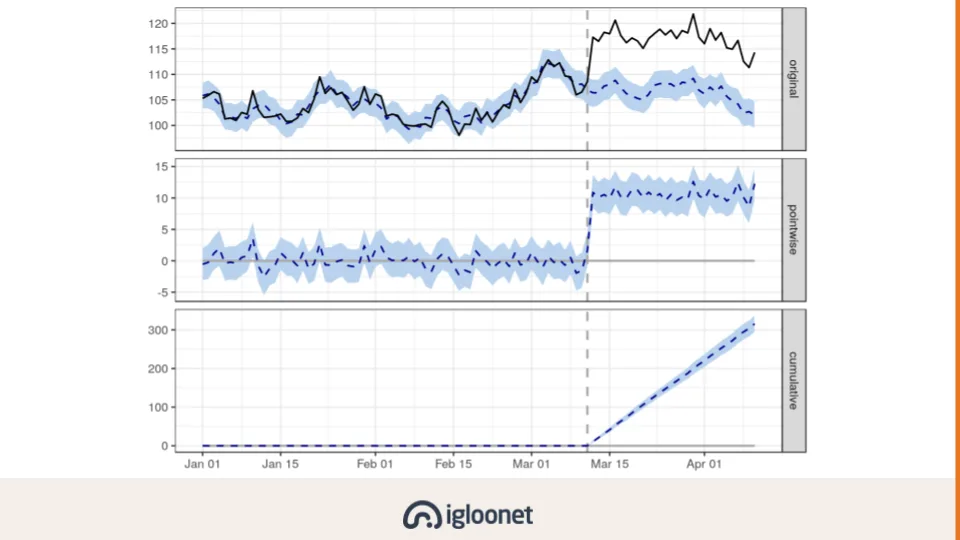
It is a beautifully elegant way to evaluate a promotion. The drawback is that CausalImpact relies on a prediction model whose last major update came 6 years ago, while forecasting methods have advanced considerably since then. To me, it makes more sense to take the Causal Impact approach and apply it to a more accurate prediction model.
GeoLift provides another way to create a control group. It compares the experiment with a synthetic control group built from geographic areas. We choose the state, region, or district where we want to run the experiment, and GeoLift calculates a weighted combination of other areas that resembled it as closely as possible before the experiment.
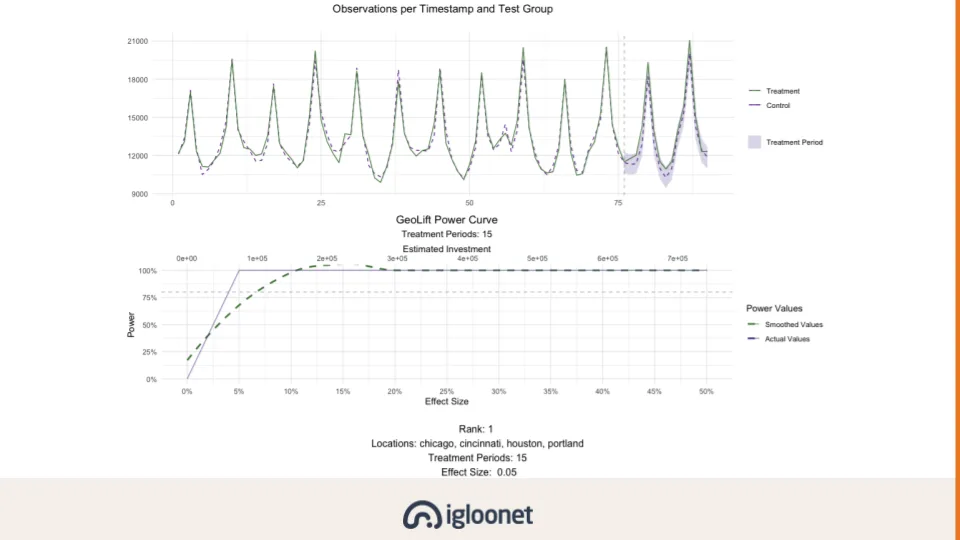
This can solve the problem of an outsized capital city. We might give the capital a weight of just 0.1 in the control mix, reflecting behavior there without letting it distort the results completely.
Working with districts and regions is always more complicated because targeting can be unreliable, so we do not use this approach often. But when we manage to incorporate geography into the experiment design, the confidence interval is usually much narrower than with CausalImpact, giving us a more precise estimate of the effect.
The hardest part of the experiment is preparing the data and, above all, getting the design right. It is far easier to decide how to evaluate an experiment before launching the campaign or reshuffling the marketing budget than after the fact. If you set everything up properly from the start (in Czech), you can save yourself a great deal of model-bending later.
Marketing Mix Modeling
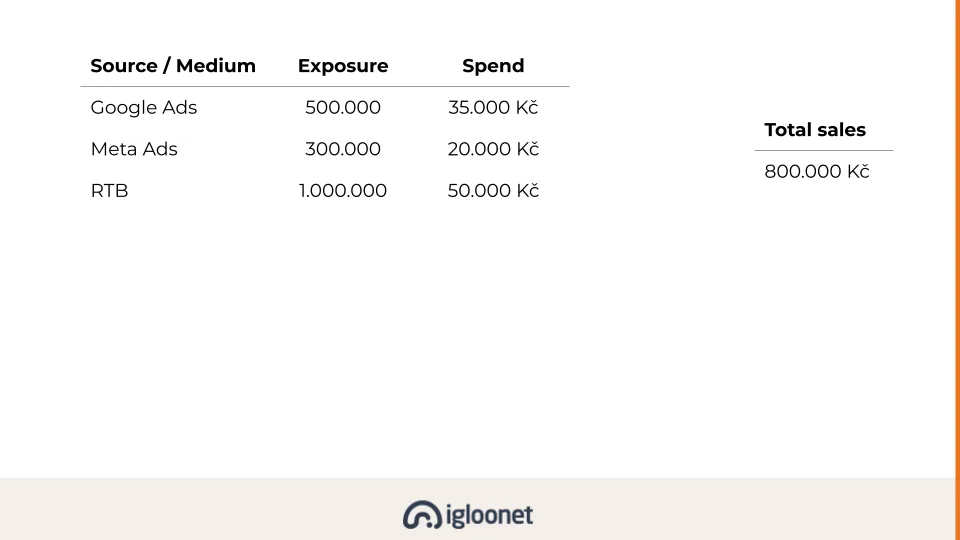
The final piece of the triangle is Marketing Mix Modeling (MMM). You may have started hearing more about it in recent years, but it rests on econometric methods that have existed for decades. Greater computing power has made it accessible to ordinary companies, not just the largest ones.
MMM's promise is, again, very elegant. We don't need to know the customer journey, and we don't depend on measuring and linking every visit. All we need are exposure metrics, usually impressions or reach, the spend in each channel, and total revenue. That means actual total revenue for the period, rather than revenue assigned to channels through attribution.
Between the two sides of the equation sits a model that tries to capture the relationships. What happens to total revenue if Google Ads impressions rise by 30%? What happens if we cut the Meta budget by 10%?
It sounds a little too good to be true. We do not depend on cookies or other tracking, so concerns about excessive intrusion into personal data disappear. We need only data from our internal systems and ad platforms. Unlike attribution, MMM also tries to quantify the baseline—what we would earn through sheer inertia and the strength of our brand—and what campaigns add on top. Surely it cannot be that simple?
I had two main objections from the start. First, every marketing activity has a lag, and that lag differs considerably by channel. Revenue from search campaigns starts arriving sooner than revenue from TV, although TV will probably have a longer tail. Second, campaigns cannot scale forever: saturation gradually sets in. Simply matching impressions and spend on one side with revenue on the other will not produce a meaningful result.
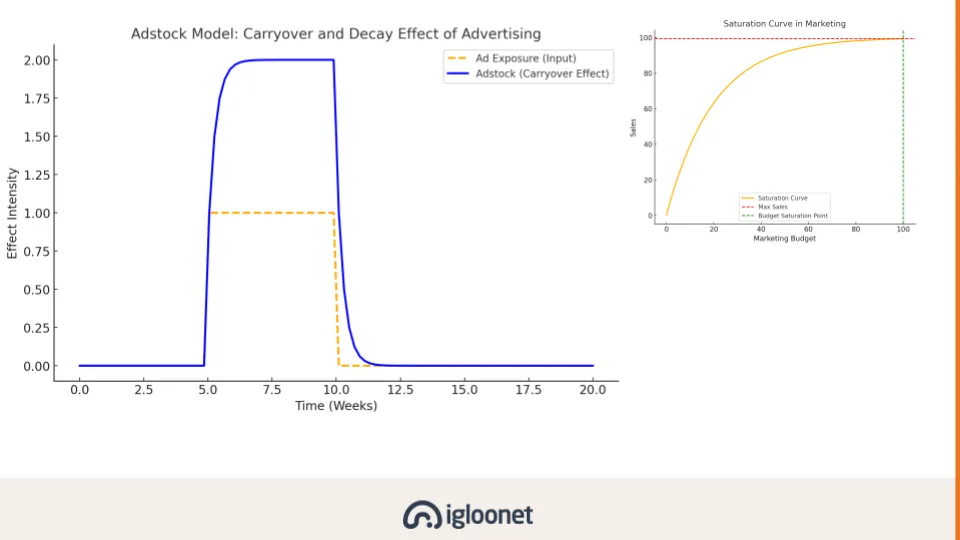
Fortunately MMM accounts for both the carry-over effect (delay + inertia) and the degree of saturation.
That makes the model considerably more complex, so it needs a lot of data to produce anything useful and estimate the relationships correctly. MMM therefore never reaches the granularity available in attribution. We use it at the level of sources or logical campaign groups, such as remarketing, search, and organic social. To capture seasonality and trends reasonably well, the model needs an absolute minimum of 2 years of data. Fortunately, data from ad platforms and internal systems is enough, so we do not need to wrestle with details such as inconsistencies between Universal Analytics and GA4.
MMM sounds great, so why not replace attribution with it? The main reasons are its low granularity—it offers little help at the campaign level—and its relatively slow response to change. Unless something moves dramatically, MMM is of little use for daily evaluation.
Triangulation
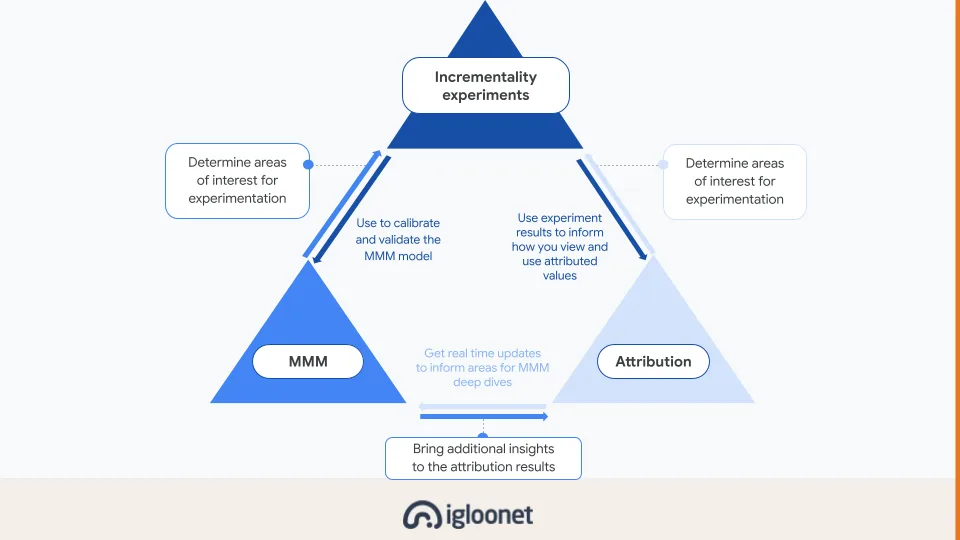
So what do we do? Attribution is not suitable for major decisions such as splitting budgets between channels. Incremental experiments are demanding to launch and evaluate. And MMM cannot handle everyday campaign optimization.
There is no single approach that answers every evaluation question. The answer is knowing which approach best fits the problem I am trying to solve.
Do I need to optimize a campaign? Attribution is perfectly adequate, because I mainly need to know whether performance has improved or worsened and how it compares with similar campaigns. Its usefulness drops toward zero once I start comparing different campaign types or campaigns at different stages of the purchase cycle.
Am I assessing the efficiency of individual channels or campaign types and trying to improve results by reallocating budget? I use Marketing Mix Modeling.
But these are all models, and we should not treat their recommendations as gospel. Incremental experiments help us verify and refine them. Suppose MMM tells me Meta is undervalued by 40%. I run an incremental experiment and find that Meta is indeed undervalued, but by something closer to 10–20%. I adjust the MMM model so it no longer overstates Meta's contribution. That will probably make another channel look undervalued, and I can repeat the process.
tl;dr
- Attribution is no longer enough for major evaluation tasks such as budget allocation.
- No other magic tool can replace it across every part of evaluation.
- That is why we use triangulation: a combination of approaches.
- We still use attribution for daily campaign optimization.
- MMM can improve overall efficiency by helping us allocate the marketing budget better.
- Incremental experiments estimate the incremental lift of a channel or campaign, helping us refine both attribution and the Marketing Mix Model.
What next?
The webinar also covered alternatives to attribution modeling. For related reading, see data preparation for expansion with Martin Anderka of GymBeam.
This article was translated from the Czech original on the igloonet blog.