
What CFOs need from marketing data

How do you talk to a CFO about data in a way that makes sense to both sides? You may be wondering which information a CFO really needs and how best to present it. Our February Penguin Webinar—igloonet's educational webinar series—offered some answers in an episode called _Data for the CFO_. Adam Šilhan was joined by Adam Bartnicki, former CFO of Slevomat Group and, after its sale to a British owner, CFO for Central Europe. Adam Bartnicki shared practical lessons from his years in financial leadership.
In the one-hour webinar, the two Adams discussed how to establish a shared language across a company, why marketers should not overlook cash flow, how to work with CLV and cohorts, and how to build a solid business case for a new investment. If the topic caught your attention but you missed the webinar, read on for the highlights and practical tips on helping finance and marketing work better together.

A shared language and unified KPIs
Successful cooperation between finance and marketing starts with a shared language. Without consistent definitions, each department ends up tracking different numbers. Marketing, for example, may not see returns and cancellations, so its revenue figure is higher than finance's. Instead of discussing what the data means and what to do with it, everyone ends up arguing over whose number is correct.
Working with CLV and cohorts
Another key topic is Customer Lifetime Value (CLV) and cohort analysis. A CFO does not need to track CLV for each individual customer. Cohorts—groups of customers acquired in the same period and in the same way—are more useful. Historical data on how these cohorts behaved makes it possible to model what might happen if we invest more money in a given channel.
💡 Want to dive deeper into CLV? Read our article _A business view of Customer Lifetime Value_.
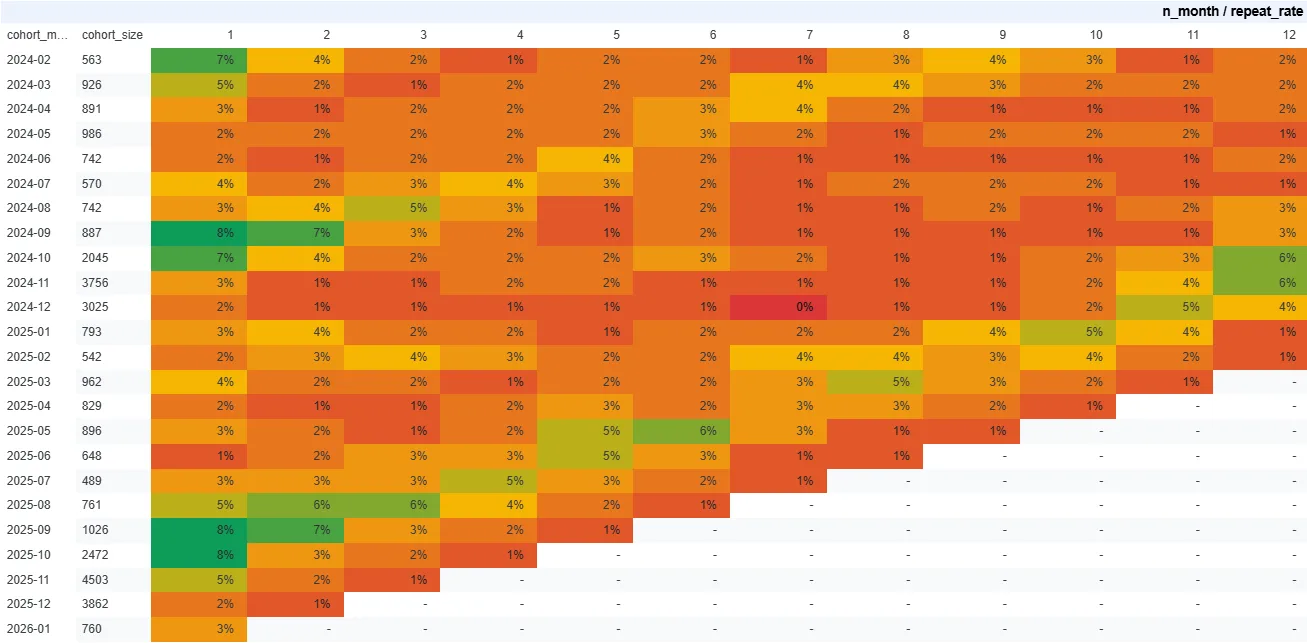
A crucial distinction is _new versus existing customers_, because the economics of the two groups are completely different. For new customers, the CFO looks at acquisition costs and repeat purchase rates. The figures depend on the industry, but at a company with a reasonable focus on retention, Adam expects 7 to 12% of new customers to buy again, averaging 1.8 purchases per year.
This leads to another useful distinction: loss leaders, acquisition products, and profit drivers—the products on which the company actually makes money. Acquisition products often carry no margin. Their purpose is to bring customers into the database so you can keep communicating with them. What matters is tracking what happens next.
The split between new and existing customers also needs to be applied by product type. For profit drivers, we track how many customers who are new to that product have already bought an acquisition product. That transition is key: if customers go on to buy a profit driver at a reasonable rate after purchasing an acquisition product, the acquisition has paid off. This lets you look back and assess whether the investment made long-term financial sense.
To track long-term value, Adam recommends the Buyers LTM metric: the cumulative number of buyers over the last 12 months. It shows how active the customer base is as a whole.
💡 He also recommends running an econometric analysis once or twice a year to evaluate how channels relate to each other and what their long-term impact is. Interested? Read about _Marketing Mix Modeling: what it is, how to work with it and what to watch out for_.
Cash flow and financial stability
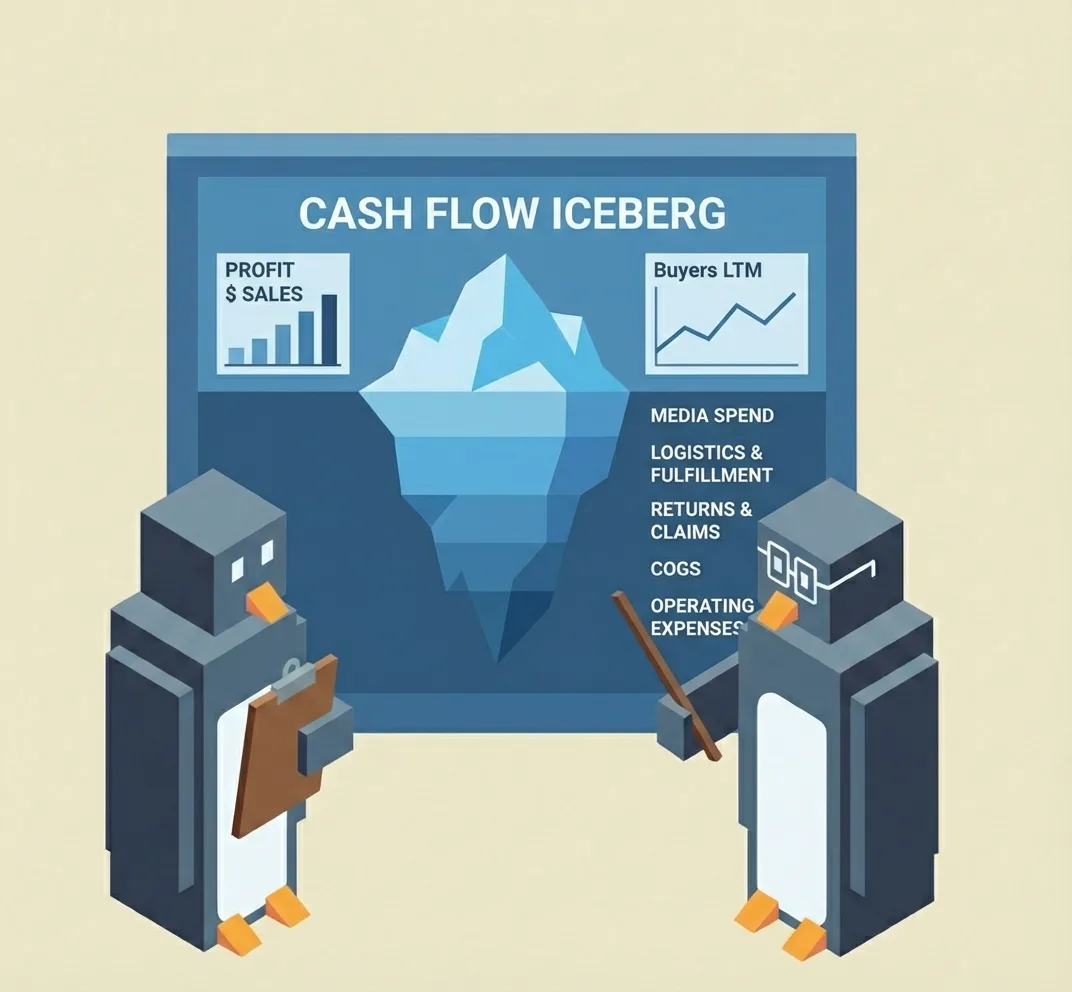
Cash flow is often the least visible area for marketers, but it is critical to a CFO. Adam gives the example of a company that grew and reached an operating profit, yet had to shut down because it had CZK 100 million (Czech koruna) tied up in inventory and no cash left to pay salaries. Profit on paper does not mean a company will survive. Similarly, a marketing campaign can show excellent returns, but its revenue may not arrive for several months, while the media invoices usually have to be paid much sooner.
How to build a business case for investments
If a marketer asks for money beyond the existing budget, they should bring a structured proposal with estimated revenue, margin, and a breakdown of fixed and variable costs. Above all, it should show a clear incremental benefit: what the investment would add beyond the status quo. The marketer and CFO can then discuss three scenarios (pessimistic, base, and optimistic) and, ideally, a pilot project with clear milestones that determine whether more capital is released.
Communication and the role of the CFO
Working with a CFO is about much more than an annual budget approval. Regular meetings make sense in practice: weekly to assess active campaigns, monthly to review the P&L and cash position, and quarterly to discuss strategy and long-term ideas. When the CFO sees value in a project, their job is not merely to police the boundaries, but to actively look for ways to fund it.
In e-commerce, a CFO has other important roles too. One is serving as the link between marketing and investors. The CFO is usually the person who communicates with shareholders and makes the case for additional investment. If marketing wants approval for a bigger campaign or new technology, the CFO has to explain the project's logic to investors and secure the capital. CFO support is about more than good relationships and pleasant meetings. It often determines whether a project gets funded at all.
In e-commerce, these roles can also be the reverse of what we are used to in traditional corporations. The marketer is often the advocate for long-term brand building while the CFO guards short-term results. In a digital business, it can work the other way around. Marketers can easily get caught up in immediate returns and daily numbers, leaving the CFO to ask uncomfortable questions about long-term impact. Black Friday is a typical example. The marketer sees revenue growth and calls the campaign a success. The CFO asks whether it is truly incremental revenue, or whether customers who would have bought later at full price simply moved their purchases forward.
Data connects the worlds of marketing and finance. But data alone is not enough when each side uses different numbers and definitions. Returns, cancellations, unused vouchers, cohort models, CLV, and cash flow are all things a CFO tracks but marketing may not see or give enough weight to. Yet this is precisely the data that determines whether a project receives capital. A marketer who can use it to build a business case speaks a language the CFO understands. In practice, that can be the difference between a project that gets approved and one that ends up in a drawer.
This article was translated from the Czech original on the igloonet blog.