
Marketing Mix Modeling: what it is, how to work with it, and what to watch out for

The good, the bad, and the ugly of Marketing Mix Modeling. What it is great at, when it does not fit, and what to watch out for. Adam wrote up the main points from the March Penguin Webinar, our educational webinar series, on evaluating marketing through the lens of MMM.
Evaluating campaign effectiveness is getting harder and harder. Legal restrictions, including cookie consent requirements, create obstacles along the customer journey. So do technical restrictions, such as the way browsers handle cookies.
That is exactly why Marketing Mix Modeling (MMM) looks like an ideal solution.
MMM is independent of cookies and privacy-friendly, and it does not mind if people use more than one device to complete a purchase. It can evaluate both online and offline activities and even calculate the "baseline": the share of revenue you would still have if you stopped all marketing activity.
You may already have much of the data a useful model needs: media spend and exposure metrics, such as impressions, GRPs, reach, and frequency, plus business KPIs such as total revenue or leads. Whether it is sufficient depends on the question, coverage, and quality of the time series.
The model then looks for relationships between media exposure and cost on one side and these KPIs on the other. It does so with some intelligence, drawing on basic marketing theory.
The model assumes that channels—and the people who interact with them—behave differently. Someone who sees a Facebook remarketing banner for new sneakers will probably buy them sooner than someone seeing them for the first time in a YouTube pre-roll. It also assumes that we cannot scale every activity forever, because eventually the law of diminishing returns kicks in.
MMM tries to handle both of these points to a certain extent:
- Adstock decay: this primarily captures how the effect of a promotional activity fades over time, though it can partly simulate a delay too;
- Saturation: this captures the effect of each additional Czech koruna (CZK) invested and how quickly that effect weakens, eventually reaching the point where another koruna has no effect at all.
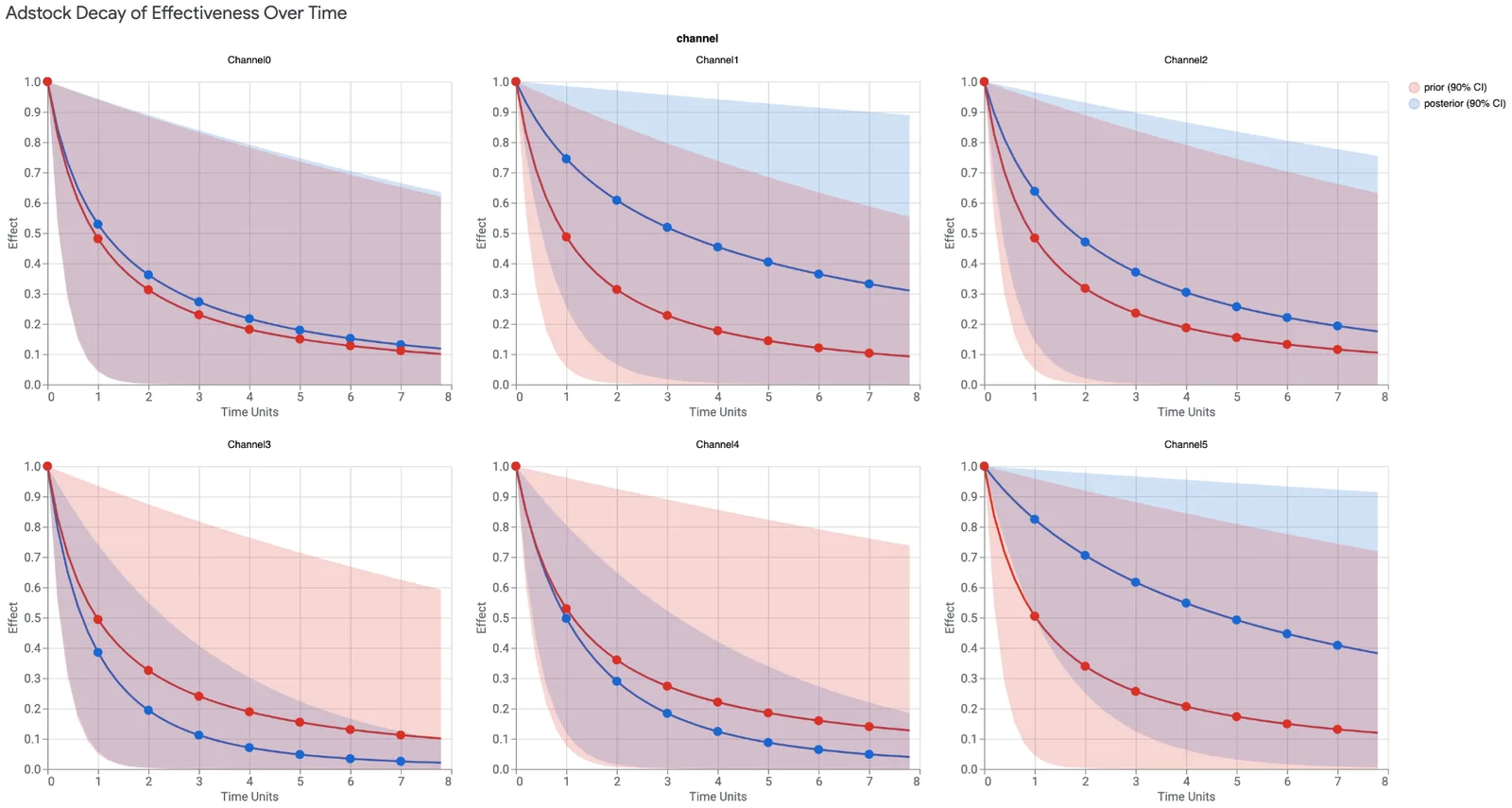
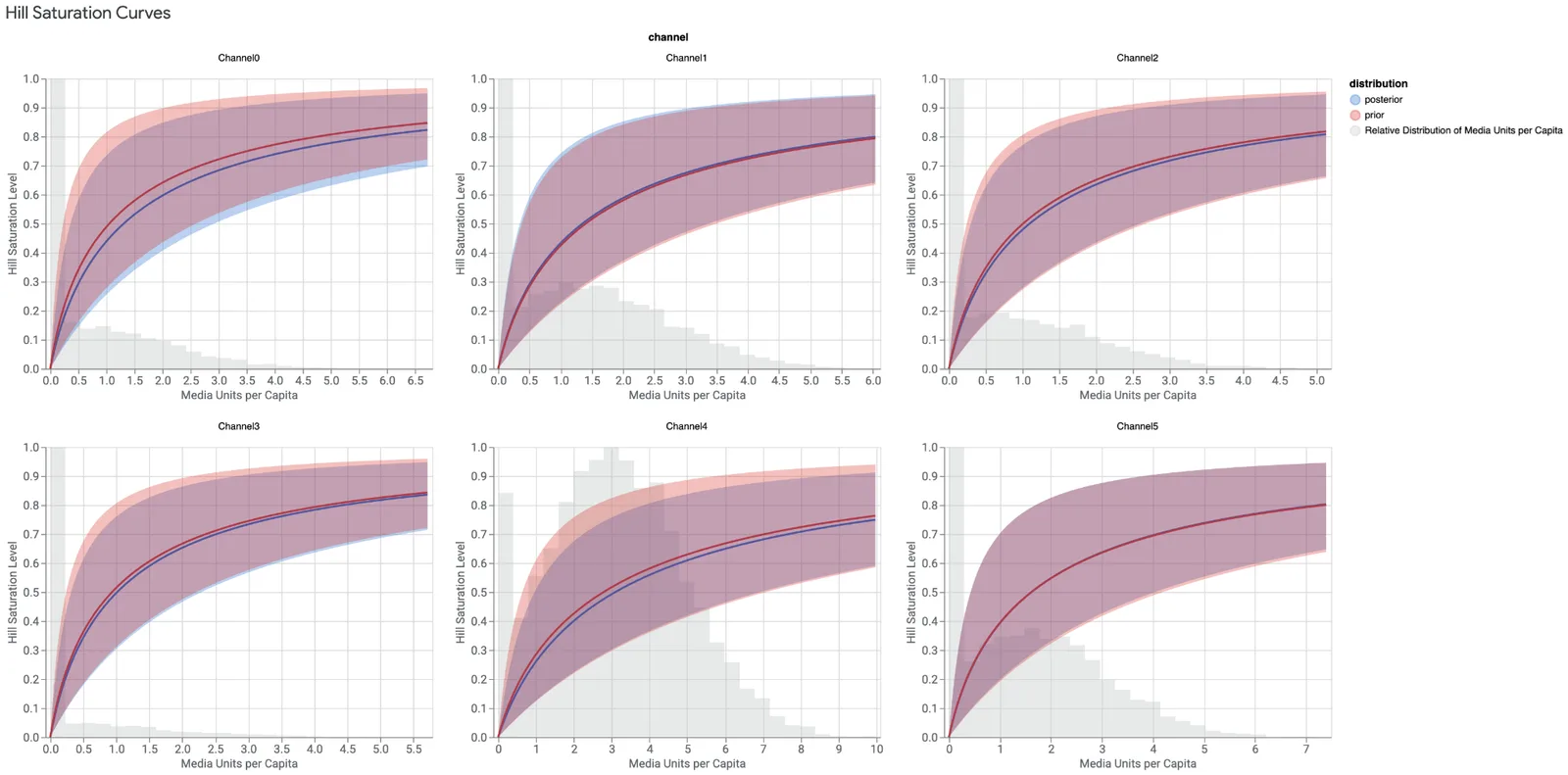

The good: when to use MMM
At present, we have no other method for calculating the effect of multiple channels on total revenue.
So if we want to make data-informed decisions about shifting budgets between channels to maximize short- or medium-term efficiency, MMM is our best option. It may be less reliable over the long term, but we have no better model for that horizon either. Beyond that, we rely on marketing theory and proxy metrics.
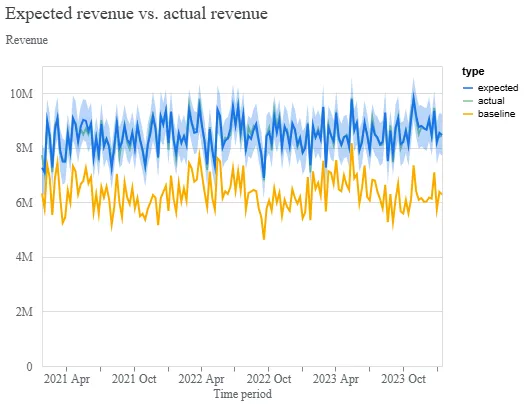
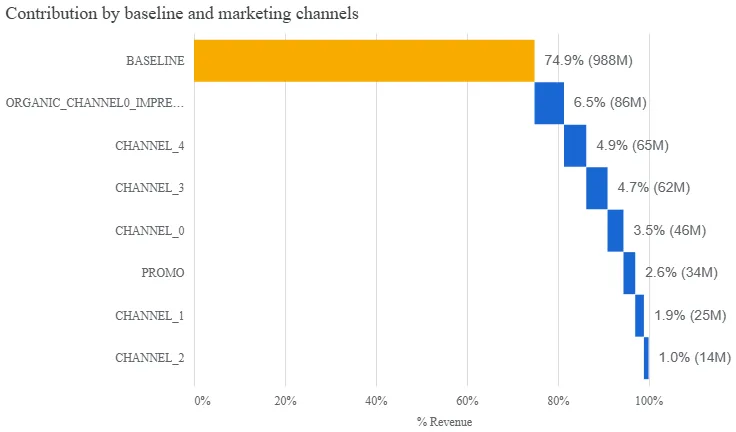
At the same time, MMM shows us both the effect of individual marketing activities and the baseline, which can be difficult for marketing teams to work with. If we are used to allocating 100% of revenue through some form of attribution, the MMM results will probably come as a surprise. We may find that 75% of revenue is actually baseline and all our marketing activity influences only the remaining 25%. The natural reaction is to slash every campaign, which is rarely good for the health of the company. That incremental 25% comes primarily from new customers, who will keep raising the baseline in the future. Ideally, then, we combine the MMM view with a customer lifetime value lens, whether through CLV or an alternative, to put the immediate impact of campaigns in better perspective.
If you can work with the baseline, or learn to, it is one of the main reasons to use MMM.

The bad: when MMM doesn't make sense
Marketing mix modeling is not a tool for managing campaigns day to day. Because of how the model works, it is best used monthly—or weekly at most—for larger budget shifts. The data will not arrive quickly enough for daily decisions, and the model will never reach the level of individual campaigns, let alone ad groups.
MMM also makes little sense if you want to test a new marketing channel. Use some form of incremental experiment instead. MMM will produce an answer, but a new channel will not have enough data points for that answer to be reliable.
If you want to use MMM for its main purpose—shifting marketing budgets—first look at how your current spend behaves. If advertising budgets change very little over time, or change in response to another factor such as the season, the model will almost certainly produce an allocation, but it may be far removed from reality. It essentially averages out the impact of the channels. One that actually performs very poorly can suddenly look quite good, and vice versa. Jonathan Hershaff, a data scientist at Airbnb, illustrates this nicely. The more scattered and "messy" your marketing data is—channels switching off at random, budgets changing significantly, and so on—the better it is for the model. If you always follow a rule such as "we put a third of our Google Ads budget into Sklik and half into Meta"—Sklik is Seznam's Czech advertising platform—you will have much more calibration work ahead of you. The same applies to campaigns that run only in season: the model will almost always overvalue them dramatically.
The correlation between parts of the model also causes problems when we evaluate affiliate marketing, remarketing, or advertising on our own brand.

The ugly: shortcomings, calibration and validation
These may look like three quite different topics, but they are all painful enough to belong in one section.
So far, we have discussed modeling promotional activity alone. MMM's real power emerges when we include other marketing variables: discount promotions, major distribution changes such as opening a new branch, or an expanded product range. This is also where companies often lose their judgment. Why not add competitors' activity, the weather, and economic trends as well? Because the more variables we add, the more data points we need. That means covering a longer period or adding another major dimension, usually geography. For technical reasons, we can generally split the data only by country. Yet comparing countries at different stages of market maturity, where our own position also differs, is not a great idea either. It is usually much better to build a separate model for each country or group of similar countries.
Could we solve that by extending the period we feed into the model? In theory, yes. In practice, we hit one fundamental problem: conditions change over time. A few years ago, for example, we had COVID, and hardly anyone would claim that campaigns worked the same during it and after it. Incentives work differently at different stages of market maturity and brand familiarity. Marketing channels and campaigns themselves change substantially too. Google Ads works very differently today from the way it did a few years ago. If we pretend these are minor nuances, the model will not warn us. It will fit the data across the period, calculate each effect, and look perfectly reasonable at first glance. Its outputs simply will not reflect reality very well. Ideally, start with a reasonably long period (1.5 to 2 years), include media channels and no more than 1–2 other variables, and add more gradually.
The third entertaining problem is the mediator-versus-confounder problem. A confounder influences both another variable and the outcome. Search volume, for example, is an excellent confounder for search campaigns because it helps isolate their impact on total revenue: how much can we improve their results by raising the budget when demand itself has not grown? A mediator, meanwhile, is influenced by another variable. Search volume is an excellent mediator for campaigns that create demand, such as TV campaigns. On one hand, we want search volume to refine our estimate of search campaign impact. On the other, demand-generating campaigns directly influence search. Since one variable cannot play both roles in the same model, we must decide whether evaluating search campaigns or demand-generating campaigns matters more. There are tricks for splitting one marketing mix model into several and treating search volume differently in each, but this is one of those cases that deserves a clear "DO NOT TRY THIS AT HOME!"
That brings us to model validation itself. How do we know whether a model produces meaningful outputs? Start by checking whether it can recover the impact of channels when we already know the answer. We generate dummy data with a known distribution and effect on revenue, feed it to the model, and see how close it gets. If it misses badly, we probably have not built the model correctly. In the second phase, we use holdout tests: we withhold part of the data and test the model's output against it. Ideally, we run several holdout tests across different periods to detect possible distortions from seasonality or other external factors. More validation techniques exist, but I consider these the two main ones. Applying just these will put you ahead of most companies trying to implement MMM.
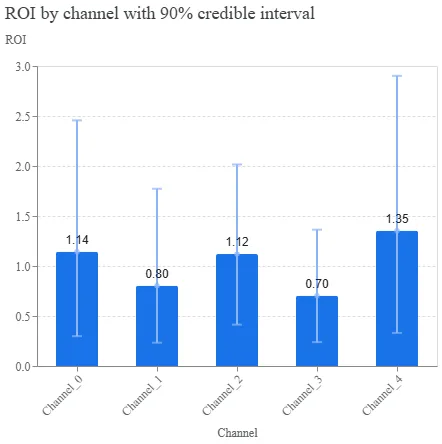
If you take campaign evaluation seriously, you have probably already run at least a few incremental experiments to measure the impact of a campaign or marketing channel. Once you have your first MMM outputs, compare the two sets of results. Do they differ? By how much? The larger the gap between the incremental experiment and the MMM output, the greater the chance that the model is poorly built. You can, of course, reassure yourself by calibrating—or bending—the model to match the experiment. But is that really the best answer? At that point, isn't the model telling us quite clearly that it cannot recover the real ROI and probably has a fundamental setup error that we should find first?
So is calibration always a bad idea, merely forcing the other variables to be recalculated with no guarantee that the output is more accurate? Could the distortion simply move somewhere else? Unfortunately, those questions have no easy answers. Meridian uses a Bayesian approach to statistics, so it anticipates a need for calibration. But calibration is a consequential decision that can throw off the entire model. Always consider whether you can improve the outputs another way.
I am especially skeptical of calibrating a model from case studies or published literature. Unless we are 100% sure how a particular study arrived at its results, adopting them blindly risks adding yet another distortion to the model.
Perhaps this article has stripped away all your illusions about MMM and left you seeing it as a dead end. In my view, that would be a big mistake. Marketing mix modeling has plenty of problems and peculiarities to account for, but that simply means we cannot run some random model—whether open source or a ready-made SaaS solution—and call it done. Most of the work lies in checking the data and validating the model.
Despite all its shortcomings, I remain convinced that a properly tuned MMM is the best tool available today for managing marketing investment as a whole.
Learn more
For a broader look at marketing evaluation, read our article on triangulation in marketing, which explains how MMM, attribution, and incremental experiments work together.
This article was translated from the Czech original on the igloonet blog.